
Privacy and Security by Design
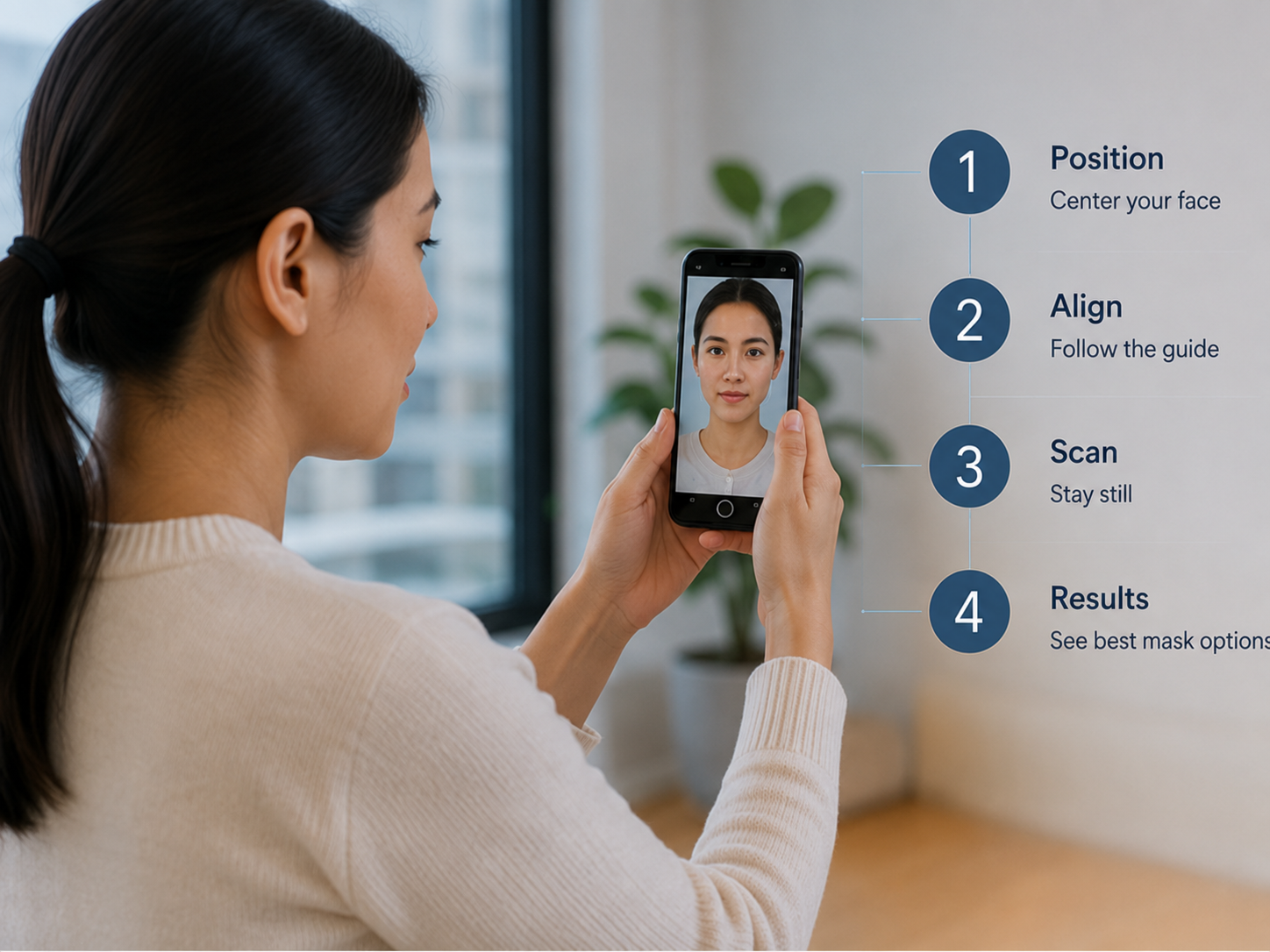
MaskFit AR is designed to use the camera for real-time measurement, not to create a stored facial photo or video record. It then protects the fitting data that is needed through encryption, controlled access, monitoring, testing, and operational safeguards.
Why privacy and security should start with the design
When people hear “cybersecurity,” they often think about passwords, firewalls, and encryption. Those protections matter, but they address only part of the risk. A more basic question comes first: how much sensitive information needs to exist in the system at all? MaskFit AR was built around that question. Instead of collecting a facial video and then deciding how to protect it, the platform is designed to calculate the measurements needed for CPAP mask fitting without saving or transmitting the patient’s facial photos or videos. This is the practical meaning of privacy by design: privacy is considered during planning, product design, development, testing, launch, maintenance, and future changes—not added later as a separate feature.Privacy and security are connected, but they are not the same
Privacy is about what information is collected, why it is needed, how it may be used, and how long it should be kept. Security is about preventing unauthorized access, alteration, loss, or misuse of the information that the platform does need. A service can have strong security technology and still create unnecessary privacy risk if it collects more information than required. MaskFit AR therefore uses two complementary approaches:- Reduce unnecessary data at the beginning of the workflow.
- Apply multiple security safeguards to the information that remains.
A face scan without creating a facial media library
During the scan, the patient’s camera provides live information about head position, angle, distance, lighting, and alignment. This real-time guidance helps the patient complete a usable scan. The camera frames are processed during the session on the patient’s device. MaskFit AR uses the results to calculate numerical fitting measurements and create a structured top match list. The scan workflow does not save or transmit the patient’s facial photos or videos. That distinction is important. A photograph or video contains far more information than the measurements needed to support CPAP mask fitting. Avoiding stored facial media reduces both the amount of sensitive information in the system and the possible impact of a future security event.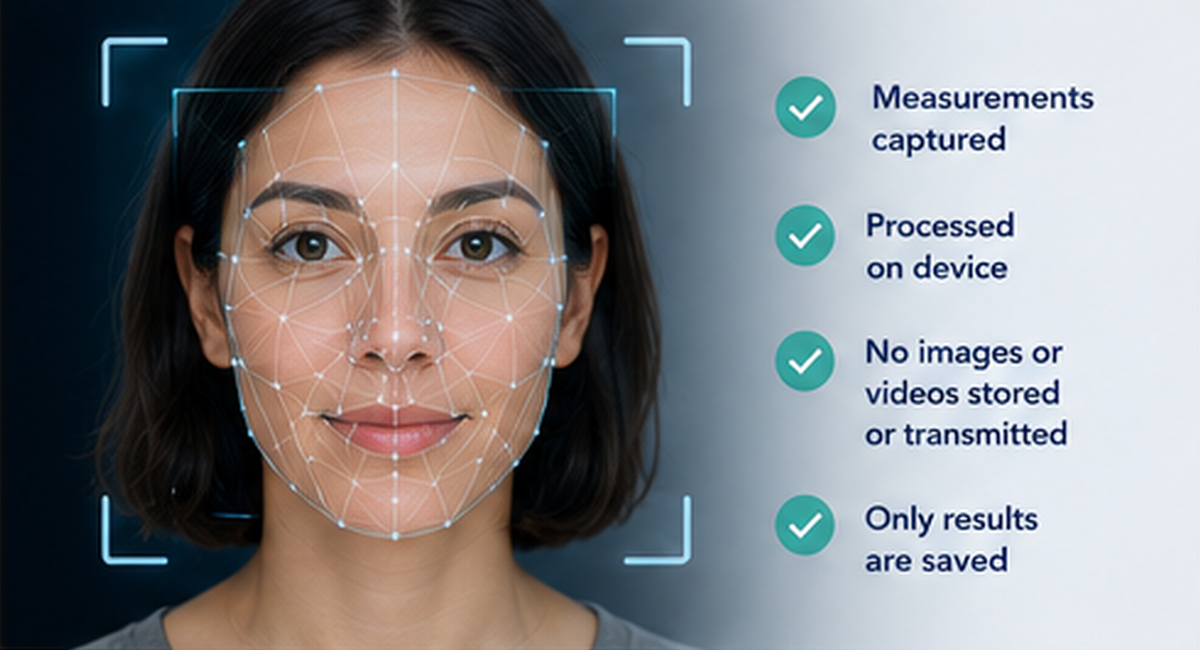
The scan workflow does not save or transmit patient facial photos or videos. Its purpose is to calculate fitting measurements, not to create a reusable image or video record.
Collect only what the workflow actually needs
MaskFit AR can support workflows that operate without broad patient identity records such as addresses, billing data, insurance data, or copies of electronic health records. A provider-assigned patient ID can be used to match the scan to the provider’s workflow without requiring MaskFit AR to hold a broader patient profile. Some workflows may still include identifying information. For example, an email address or phone number may be used when MaskFit AR is asked to deliver a scan link directly. A provider may also choose to include a patient name, date of birth, or other fields for its own operational needs. The goal is not to claim that every workflow is anonymous. The goal is to allow healthcare organizations to avoid information that is not required for the fitting task.
Collecting less is not a substitute for security. It reduces the amount of sensitive information that must be secured in the first place.
Keep the fitting workflow separated from unrelated systems
MaskFit AR can operate as a focused fitting platform rather than requiring broad access to a provider’s electronic health record, billing system, insurance platform, or document repository. Patients can receive a controlled scan link, complete the fitting, and return results to the provider through the MaskFit AR workflow. This separation follows a simple security principle: a system should have access only to what it needs to perform its job. Limiting connections and permissions can reduce the number of pathways through which unrelated information could be exposed.Protect information while it moves and while it is stored
The fitting measurements, account information, and workflow data that the platform does need are protected during transmission and storage.- Encrypted connections protect information moving between the user’s browser, MaskFit AR, and authorized connected systems.
- Sensitive platform data and associated backups are encrypted while stored in the cloud.
- Encryption keys are managed separately through cloud key-management services.

Limit who can access the platform
Security also depends on making sure that the right people have the right level of access—and no more.- Role-based access: Organizations can limit features and information according to each user’s responsibilities.
- Two-factor authentication: An additional sign-in check can reduce the risk of unauthorized access and is strongly recommended.
- Controlled administrative access: Higher-privilege accounts are more tightly restricted.
- Activity records: User and activity logs support review of who accessed the platform and what actions occurred.
- Access reviews: Former, dormant, or over-privileged accounts can be identified and changed or removed.

Monitor for unusual activity and weaknesses
Security is not a one-time setup. MaskFit AR uses monitoring and review processes to identify suspicious activity, software vulnerabilities, sensitive-data patterns, and important changes within its cloud environment. Security findings are reviewed and prioritized as part of an ongoing hardening process. The platform also uses application safeguards intended to reduce common web risks, secure password hashing, authenticated APIs, protected backups, and disaster-recovery procedures.
Independent testing is a tool for improvement—not a promise of perfection
MaskFit AR conducts periodic security reviews and penetration testing. A penetration test is an authorized attempt by an independent security specialist to find weaknesses in an application before a malicious attacker does. An independent 2025 assessment reviewed the MaskFit AR web application from the perspective of a general internet user and an authorized user. The assessment identified findings across several severity levels and provided improvement recommendations. That is the purpose of responsible testing: discover issues, prioritize remediation, strengthen controls, and test again. A penetration test is not proof that a platform has no vulnerabilities, and no connected system can honestly promise zero risk. It is one component of a continuing security program.Technology is only one part of security
Strong software controls are important, but people and operating practices also matter. AR Medical Technologies maintains written policies covering privacy, access management, secure development, data handling, employee and contractor responsibilities, incident response, backups, risk assessment, and third-party management. Employees and contractors receive privacy and security training. Administrative devices are expected to be secured and updated. Incident-response procedures define how the company reviews, contains, investigates, documents, and communicates security events when necessary. These operational measures help turn technical safeguards into repeatable organizational practices.What patients and providers should understand
- MaskFit AR uses the camera to calculate fitting measurements; it does not save or transmit facial photos or videos as part of the scan.
- The platform can be configured to minimize patient identifiers, but the exact information used depends on the provider’s workflow.
- MaskFit AR does not require broad access to EHR, billing, insurance, or document-management systems to perform a fitting.
- Encryption, access controls, monitoring, backups, testing, staff training, and incident-response processes work together as layered protections.
- No online platform can guarantee zero risk. Responsible security means reducing exposure, finding weaknesses, and improving continuously.

Final takeaway
Patients should not have to choose between a convenient digital fitting experience and reasonable protection of their information. MaskFit AR addresses both by starting with data minimization. It processes camera input in real time, avoids saved or transmitted facial photos and videos, and can support workflows that limit broader patient identifiers and system access. It then protects the information that remains through encryption, role-based access, monitoring, testing, backups, staff practices, and incident-response planning.Security is not simply an added feature of MaskFit AR. It is part of how the fitting workflow is designed and how the platform is operated over time.
Product note: MaskFit AR’s fitting technology is protected by U.S. Patent No. 12,475,998. Patent protection relates to the underlying technology and should not be interpreted as a certification of privacy or security.