
Understanding the Main Types of CPAP Masks
A simple guide to the mask styles shown in MaskFit IQ.
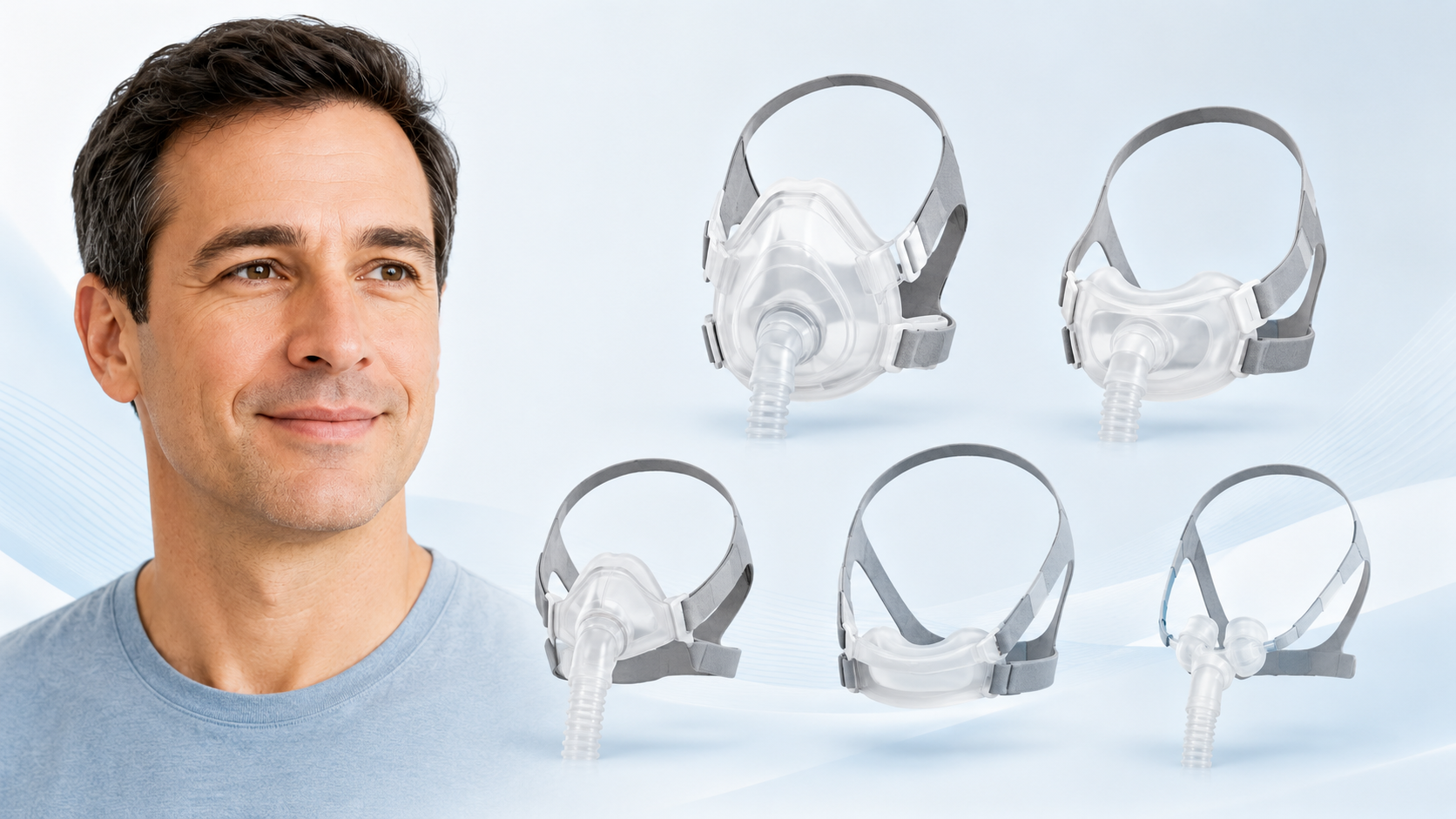 Most CPAP masks fall into a few main groups. In MaskFit IQ, masks are organized into five practical style categories:
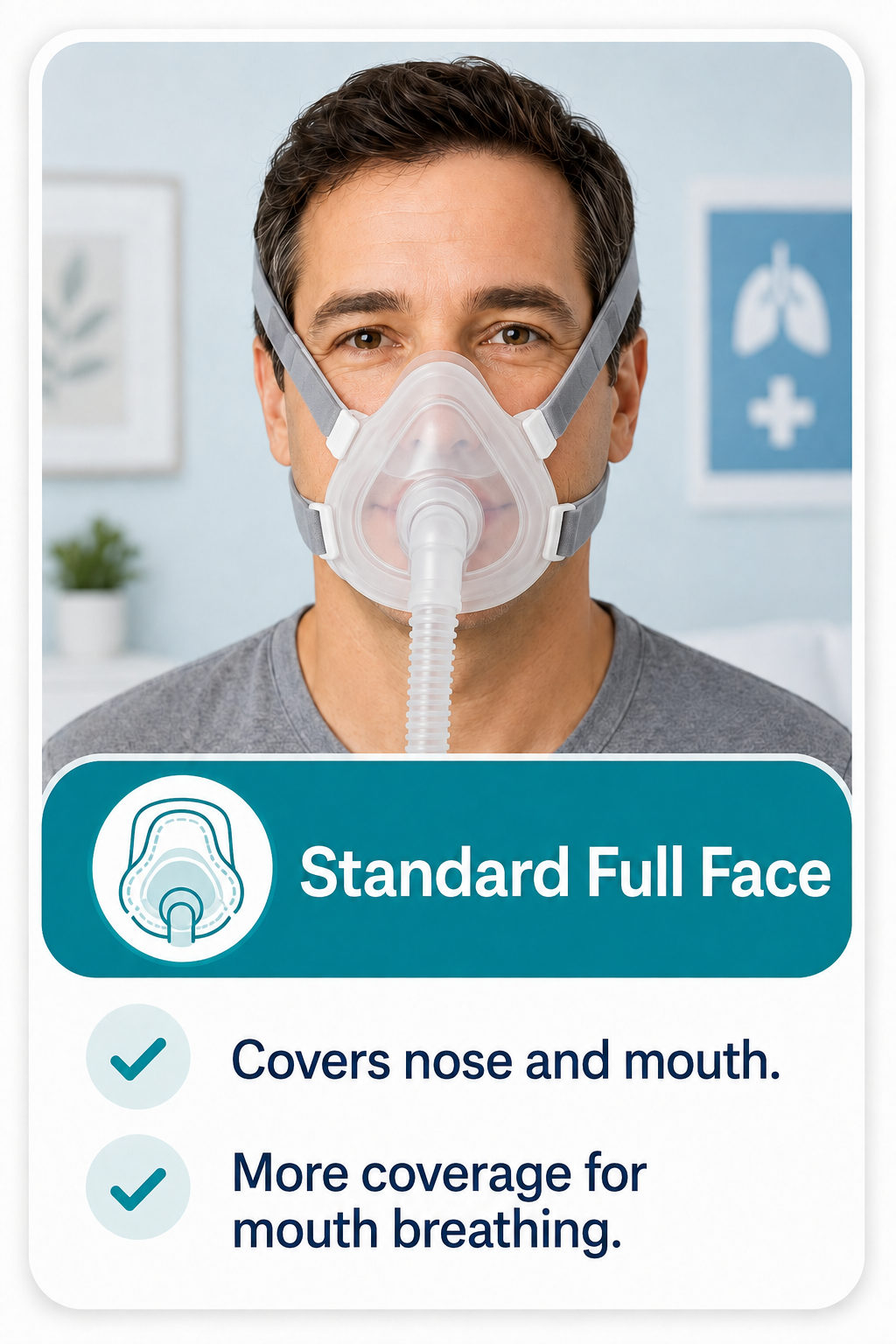 A standard full face mask covers both the nose and mouth. It usually sits over the bridge of the nose and seals around the nose and mouth area.
This style may be helpful for some people who breathe through their mouth during sleep, have nasal congestion, or need a mask that allows breathing through both the nose and mouth. However, mouth breathing does not automatically mean a full face mask is the only option. Some patients may still do well with a nasal or nasal pillow style depending on their comfort, seal, therapy settings, and provider guidance.
May be a good fit if you:
A standard full face mask covers both the nose and mouth. It usually sits over the bridge of the nose and seals around the nose and mouth area.
This style may be helpful for some people who breathe through their mouth during sleep, have nasal congestion, or need a mask that allows breathing through both the nose and mouth. However, mouth breathing does not automatically mean a full face mask is the only option. Some patients may still do well with a nasal or nasal pillow style depending on their comfort, seal, therapy settings, and provider guidance.
May be a good fit if you:
 An under nose full face mask covers the mouth and sits under the nose instead of covering the bridge of the nose.
This style may be useful for people who need mouth coverage but want a more open design around the upper nose and eyes. Some patients prefer this style because it may feel less bulky than a traditional full face mask.
Like a standard full face mask, this is not the only possible option for mouth breathing. It is one style to consider if mouth leak, dry mouth, nasal congestion, comfort, or provider guidance suggest that mouth coverage may be helpful.
May be a good fit if you:
An under nose full face mask covers the mouth and sits under the nose instead of covering the bridge of the nose.
This style may be useful for people who need mouth coverage but want a more open design around the upper nose and eyes. Some patients prefer this style because it may feel less bulky than a traditional full face mask.
Like a standard full face mask, this is not the only possible option for mouth breathing. It is one style to consider if mouth leak, dry mouth, nasal congestion, comfort, or provider guidance suggest that mouth coverage may be helpful.
May be a good fit if you:
 A standard nasal mask covers the nose only. It usually seals around the bridge, sides, and lower part of the nose.
This style is often a middle-ground option. It provides more structure than nasal pillows but covers less of the face than a full face mask.
May be a good fit if you:
A standard nasal mask covers the nose only. It usually seals around the bridge, sides, and lower part of the nose.
This style is often a middle-ground option. It provides more structure than nasal pillows but covers less of the face than a full face mask.
May be a good fit if you:
 An under the nose nasal mask sits below the nose instead of covering the full nose. It is sometimes called a nasal cradle style.
This style may feel more open because it avoids the bridge of the nose and leaves more of the face uncovered.
May be a good fit if you:
An under the nose nasal mask sits below the nose instead of covering the full nose. It is sometimes called a nasal cradle style.
This style may feel more open because it avoids the bridge of the nose and leaves more of the face uncovered.
May be a good fit if you:
 A standard nasal pillow mask is one of the smallest CPAP mask styles. It uses soft cushions that sit at or near the nostrils and deliver air directly into the nose.
This style may be a good fit for people who want the least amount of material on the face.
May be a good fit if you:
A standard nasal pillow mask is one of the smallest CPAP mask styles. It uses soft cushions that sit at or near the nostrils and deliver air directly into the nose.
This style may be a good fit for people who want the least amount of material on the face.
May be a good fit if you:
 Choosing a CPAP mask is not only about the mask type. It is also about your daily comfort and how you sleep.
Do you breathe through your nose or mouth?
If you mostly breathe through your nose, a standard nasal, under the nose nasal, or nasal pillow mask may be an option. If you often breathe through your mouth, that does not automatically mean you must use a full face mask. Some people still do well with nasal-style masks, while others may benefit from a standard full face or under nose full face style. Your comfort, mask seal, dry mouth symptoms, nasal congestion, therapy experience, and provider guidance all matter.
Do you feel uncomfortable with larger masks?
Some people prefer nasal pillows or under-the-nose designs because they feel more open.
Do you sleep on your side?
Some masks may shift more easily depending on your sleep position. A smaller mask may feel easier for some side sleepers, but fit and seal still matter.
Do you wear glasses before bed?
Nasal pillow and some under-the-nose designs may make it easier to wear glasses before going to sleep.
Do you have facial hair?
Facial hair can affect how some masks seal. A different cushion style or mask type may help.
Do you get dry mouth?
Dry mouth can happen for different reasons, including mouth breathing, mask leak, humidity settings, nasal congestion, or other comfort issues. If this is happening, talk with your care team before changing masks. A full face style may help some patients, but it is not always the only solution.
Choosing a CPAP mask is not only about the mask type. It is also about your daily comfort and how you sleep.
Do you breathe through your nose or mouth?
If you mostly breathe through your nose, a standard nasal, under the nose nasal, or nasal pillow mask may be an option. If you often breathe through your mouth, that does not automatically mean you must use a full face mask. Some people still do well with nasal-style masks, while others may benefit from a standard full face or under nose full face style. Your comfort, mask seal, dry mouth symptoms, nasal congestion, therapy experience, and provider guidance all matter.
Do you feel uncomfortable with larger masks?
Some people prefer nasal pillows or under-the-nose designs because they feel more open.
Do you sleep on your side?
Some masks may shift more easily depending on your sleep position. A smaller mask may feel easier for some side sleepers, but fit and seal still matter.
Do you wear glasses before bed?
Nasal pillow and some under-the-nose designs may make it easier to wear glasses before going to sleep.
Do you have facial hair?
Facial hair can affect how some masks seal. A different cushion style or mask type may help.
Do you get dry mouth?
Dry mouth can happen for different reasons, including mouth breathing, mask leak, humidity settings, nasal congestion, or other comfort issues. If this is happening, talk with your care team before changing masks. A full face style may help some patients, but it is not always the only solution.
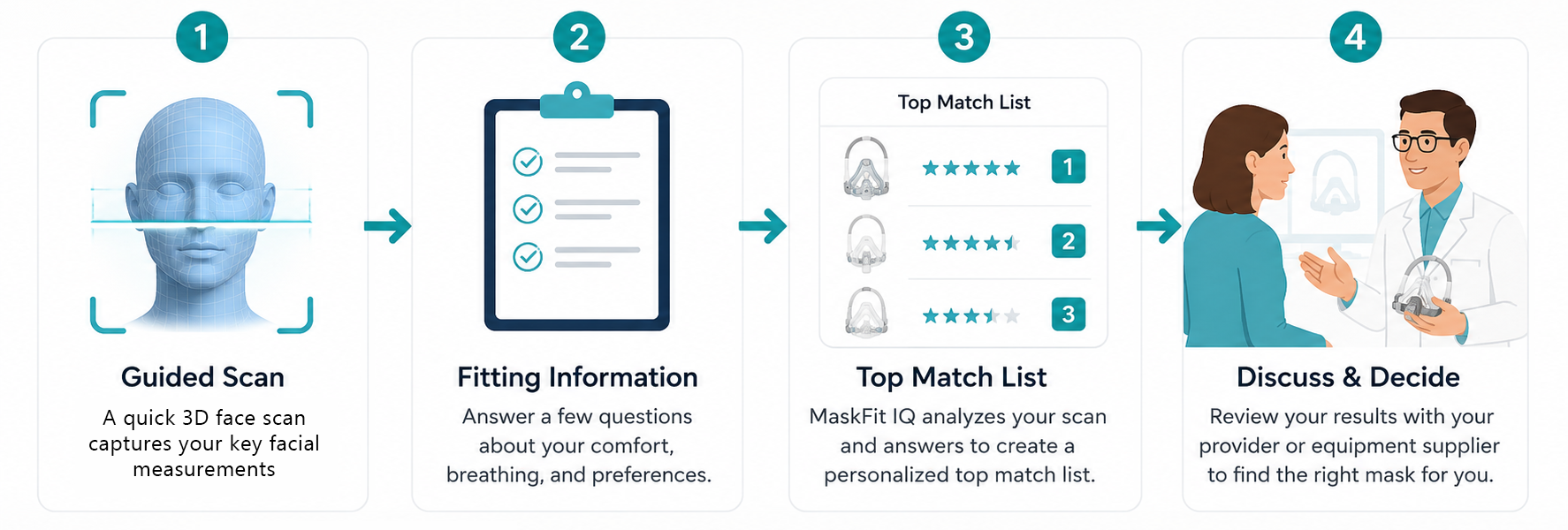 MaskFit IQ is designed to support the mask fitting process by using a guided digital workflow.
Instead of asking patients to guess from a long product list, MaskFit IQ helps create a structured top match list based on the scan and fitting information.
The goal is not to replace your care team or make the final decision for you. The goal is to make the mask selection process easier to understand and more informed.
Your final mask choice may still depend on comfort, provider guidance, product availability, follow-up experience, and personal preference.
MaskFit IQ is designed to support the mask fitting process by using a guided digital workflow.
Instead of asking patients to guess from a long product list, MaskFit IQ helps create a structured top match list based on the scan and fitting information.
The goal is not to replace your care team or make the final decision for you. The goal is to make the mask selection process easier to understand and more informed.
Your final mask choice may still depend on comfort, provider guidance, product availability, follow-up experience, and personal preference.
Key takeaway
CPAP masks come in different styles, and each style is designed to fit and feel a little differently. The right mask depends on how you breathe during sleep, what feels comfortable, how well the mask seals, and what your care team recommends. MaskFit IQ helps organize this process by showing a structured top match list based on your scan and fitting information.
CPAP masks are not all the same
Starting CPAP therapy can feel overwhelming at first. There are different machines, tubes, mask shapes, cushion styles, and headgear designs. One of the most important parts of getting comfortable with therapy is finding a mask style that works for your breathing habits, face shape, and comfort preferences.- Standard Full Face
- Under Nose Full Face
- Standard Nasal
- Under the Nose Nasal
- Standard Nasal Pillow
Standard Full Face Mask
- Often breathe through your mouth during sleep and have difficulty with nose-only masks
- Wake up with a dry mouth or mouth leak while using a nasal-style mask
- Need more coverage than a nasal mask provides
- Want one mask that allows breathing through both the nose and mouth
- It covers more of the face than other mask styles
- Comfort and seal are very important
- The mask should feel secure, not overly tight
- Some people may need time to adjust to the larger feel
Under Nose Full Face Mask
- Breathe through your mouth during sleep and need mouth coverage
- Have tried nose-only masks and still experience mouth leak or dry mouth
- Want full face coverage with a more open feel
- Prefer less material near the bridge of the nose
- Want a design that keeps the upper face more open
- It still needs a good seal around the mouth and under the nose
- The under-nose area plays an important role in comfort and fit
- Different models may feel very different even within the same style
- Some designs may route tubing over the head, but in MaskFit IQ this is included within the under nose full face style, not treated as a separate style
Standard Nasal Mask
- Breathe mainly through your nose
- Want a stable mask that does not cover the mouth
- Prefer a more traditional nasal mask feel
- Want a mask style available in many shapes and sizes
- Mouth breathing can affect how well this style works, but it does not always rule it out
- The cushion should seal around the nose without feeling painful
- Tightening the straps too much can sometimes make leaks worse
- Different standard nasal masks may feel different depending on cushion shape and headgear design
Under the Nose Nasal Mask
- Breathe mainly through your nose
- Want less contact on the bridge of the nose
- Prefer a more open design
- Feel uncomfortable with a traditional nasal mask
- The cushion position under the nose matters
- A good seal is still important
- It may feel different from a standard nasal mask even though both are nose-only styles
- It does not cover the mouth, so mouth leak or dry mouth should be discussed with your care team
Standard Nasal Pillow Mask
- Want a small, lightweight mask
- Prefer minimal facial contact
- Wear glasses before bed
- Feel uncomfortable with larger masks
- The seal around the nostrils is very important
- Some people need time to get used to direct airflow into the nose
- It may not be the best fit for everyone who regularly breathes through the mouth, but some patients may still do well with this style depending on their therapy experience and provider guidance
- Nostril size and shape can matter more with this style
Why MaskFit IQ separates these styles
Small design differences can make a big difference in how a mask feels. A standard nasal mask and an under the nose nasal mask may both be nose-only masks, but they do not sit on the face the same way. A standard full face mask and an under nose full face mask both allow mouth coverage, but they can feel very different around the nose and eyes. That is why MaskFit IQ uses practical mask style groups. The goal is to help patients better understand their top match list and make it easier to discuss options with a provider, clinic, DME, or equipment supplier.How to think about mask choice
How MaskFit IQ can help
Simple comparison
Standard Full Face: Covers the nose and mouth. May be helpful for some people who need mouth coverage, have mouth leak, or have difficulty with nose-only masks.
Under Nose Full Face: Covers the mouth and sits under the nose. May be helpful for people who need mouth coverage but want a more open feel around the upper nose.
Standard Nasal: Covers the nose only. May be helpful for people who breathe mainly through the nose, and may still work for some patients who occasionally mouth breathe depending on comfort, seal, and provider guidance.
Under the Nose Nasal: Sits under the nose and keeps the mouth uncovered. May be helpful for people who want a more open nose-only design.
Standard Nasal Pillow: Sits at or near the nostrils. May be helpful for people who want the smallest and lightest mask style.